
In partnership with


Netflix buys Warner Bros. Discovery in landmark deal

Mario Tama / Getty Images
Look out for that Harry Potter cameo in Stranger Things. Late last week, Netflix announced an agreement to buy WBD’s streaming and studio businesses for $82.7 billion, outbidding Paramount Skydance and Comcast.
The deal, if approved by regulators, would completely transform Hollywood and solidify Netflix as the most dominant player in the entertainment industry.
A blockbuster agreement
Under the megadeal, Netflix will pay around $27.75 per share (with stock in the company included) for all of WBD’s film and television studios plus its streaming assets.
So what exactly has Netflix purchased? Well, under the terms of the agreement, Netflix will now own:
Warner Bros. Film Studio. Now, Netflix will be able to do what it pleases with a massive IP library, from titles ranging from Batman to Harry Potter to The Lord of the Rings, along with beloved classics like The Wizard of OZ, Looney Tunes, and Friends.
The entire HBO and HBO Max catalog. That means Netflix will now have control of what is arguably TV’s most historic brand, on top of content like Game of Thrones and Succession. It’s still unclear whether Netflix will fold HBO Max into its own platform or let it continue as a standalone streaming service.
What doesn’t Netflix get? Netflix is steering clear of WBD’s traditional cable networks (like CNN and TNT), which will instead be split off into their own company sometime next year.
Why is this such a big deal?
If the agreement gets approved by regulators, Netflix will gain ownership of one of Hollywood’s richest content libraries, which has left a lot of people worried about the future of the entertainment industry:
An anonymous group of Hollywood A-listers sent an open letter to Congress voicing their concern, saying Netflix’s acquisition of WBD could prove to be a disaster for the film industry.
Many observers worry that the deal could strike a fatal blow to movie theaters, as Netflix has historically avoided releasing its biggest projects outside of streaming. That said, Netflix claims WBD projects will continue to be released in cinemas.
When does the deal close? Netflix aims to finalize the deal next year, but it still faces massive regulatory scrutiny, especially amid antitrust concerns. President Trump (who is believed to have favored Paramount’s offer) could prove to be another hurdle, as he recently said he would be involved in the deal’s approval and that the acquisition “could be a problem” because of how much market share Netflix could end up with.
Speaking of Paramount… the entertainment giant announced yesterday it would launch a hostile takeover bid (see explanation), going directly to shareholders with an $108 billion offer in an attempt to overwrite Netflix’s agreement with WBD. Let the games begin.

Meta is finally giving up on its namesake

Kelly Sullivan / Getty Images
Stockholders jumped for joy after this one. After years of struggling to launch his metaverse vision, Meta CEO Mark Zuckerberg announced the company plans to reduce the company’s investment in the project, most likely to double down on AI investment.
A fading dream
The shift in priorities for Meta will, as expected, mostly affect the company’s metaverse division (dubbed Reality Labs), which oversees virtual‑reality and augmented‑reality products. According to reports:
Meta will reduce its metaverse spending by as much as 30% in 2026, and employee layoffs could begin as soon as January.
The cuts come after Meta already laid off over 100 Reality Labs employees earlier this year.
It marks the likely end of Zuckerberg’s dream: Back in 2021, Zuckerberg rebranded Facebook as Meta, highlighting the company’s switch in focus to VR tech that would be “a successor to the mobile internet.” However, that vision has struggled to come to fruition, as Reality Labs has racked up more than $70 billion in losses since the rebrand.
That’s probably why investors are happy
Meta’s stock surged over 3% after the announcement, adding tens of billions to its market cap, as investors welcomed Zuckerberg’s move to scale back the metaverse, an initiative long viewed as a money-losing venture and a potential safety risk for minors.
So, what now? Cutting back its metaverse ambitions should allow Meta to concentrate more on AI (especially after its latest chatbot, Llama 4, fell short) and focus on its Ray-Ban smart glasses, which have continued to impress in the mixed-reality tech industry, a field where Apple, Google, and Snapchat have all struggled.

Chernobyl’s radiation shield “lost safety function” after drone strike

Andrew Kravchenko / Bloomberg via Getty Images
Here comes the radiation-eating fungus. Called it. The United Nations’ nuclear watchdog reported over the weekend that Chernobyl’s protective shield, known as The New Safe Confinement (NSC), can no longer contain radioactive waste after a drone strike damaged it earlier this year.
A concrete dome
The New Safe Confinement is a massive hangar-like structure built from 2010 to 2019 with donations from over 45 countries:
Created in response to the 1986 Chernobyl nuclear disaster, the NSC was designed to isolate the unstable reactor core and prevent the release of radioactive material.
The massive radiation shield was made to enclose Chernobyl’s sarcophagus, an emergency concrete and steel structure built after the meltdown, and withstand the elements for over a century (watch a video overview here).
How did we get here?
On February 14, a drone carrying a high-explosive warhead struck the NSC over Chernobyl’s fourth reactor, puncturing the outer shell and spreading a fire inside the shelter.
After the strike, no reports of radiation leaks surfaced, and authorities pledged to monitor radiation levels at the site.
However, later tests by the International Atomic Energy Agency revealed the shelter’s ability to fully contain radiation and prevent the escape of radioactive dust had faltered.
While current radiation sensors report no catastrophic leaks, experts say any further damage to its outer shell significantly increases the risk that large amounts of radioactive dust could escape, especially as the structure is exposed to weather, corrosion, and stress over time.
Looking forward: Repairing and restoring the NSC is technically complex and costly, particularly in a combat zone, and the shelter’s ability to prevent contamination could continue to degrade.
In partnership with Roku
Shoppers are adding to cart for the holidays

Over the next year, Roku predicts that 100% of the streaming audience will see ads. For growth marketers in 2026, CTV will remain an important “safe space” as AI creates widespread disruption in the search and social channels. Plus, easier access to self-serve CTV ad buying tools and targeting options will lead to a surge in locally-targeted streaming campaigns.
Read our guide to find out why growth marketers should make sure CTV is part of their 2026 media mix.

Apple is losing all of its top talent

Sean Gallup / Getty Images
When even Justin Bieber weighs in, you know it’s bad. With Apple lagging in the AI race, a string of high-profile departures across key divisions has put the company on its heels as it hunts for replacements.
A rotting fruit
Throughout the year, the tech giant has seen a wave of exits amid its AI push, with over a dozen executives and researchers leaving for rival companies or announcing retirement.
However, the past week has been particularly bad:
John Giannandrea, Apple’s long-time head of machine learning and AI strategy, announced he will retire.
Alan Dye, the VP of interface design and mastermind behind the new Liquid Glass design, is joining Meta.
Apple’s General Counsel, Kate Adams, said she will be retiring next year.
Last but not least, the company’s VP of environment, policy, and social initiatives, Lisa Jackson, is also retiring in 2026.
Giannandrea, Apple’s AI chief, was chased out of the company after the tech giant failed to turn its world-class hardware into meaningful AI gains (with Siri or Apple Intelligence), effectively surrendering the chatbot race to OpenAI’s ChatGPT and Google’s Gemini.
Anddd they’re bound to lose more: Johny Srouji, Apple’s senior VP of hardware technologies and the architect of its in-house chip program, has told CEO Tim Cook he’s thinking about jumping ship, prompting the company to scramble for ways to keep him, per Bloomberg.
One company is benefiting from this the most… Apple’s rival Meta. At least nine former Apple employees affiliated with AI research or engineering have joined Meta, many into its newly accelerated “Superintelligence” labs. Others have joined other AI-focused firms like OpenAI or smaller specialized startups, signaling Apple is losing the AI race in a very big way.

These “cute” cars might be coming to America for the first time

Kazuhiro Nogi / AFP via Getty Images
We’ve found the president’s newest obsession. On Friday, President Trump announced that he has “approved TINY CARS to be built in America,” to help give Americans more affordable automotive choices.
What are these “TINY CARS”?
The little cars the president was referring to are kei cars (pronounced “kay”), a special Japanese category for vehicles (cars, trucks, or vans) no larger than 11 feet long, 4.9 feet wide, and 6.6 feet tall.
Kei cars are ultra-compact vehicles popular in Japan, and for good reason:
They’re small enough to navigate narrow city streets, and pretty affordable. A new kei car can cost around $9,000–$13,000, with used ones going anywhere from $4,000–$8,000.
Not to mention, their small size and modest engine power make them fuel-efficient and cheap to run.
They make up a large share of new-car sales in the island nation, partly because of generous tax and regulatory advantages. But can they succeed in America? Critics aren’t so sure.
Small car, big country
While President Trump said carmakers should be able to start building the “very small” and “really cute” cars in US factories, they’d likely face heavy regulatory and practical roadblocks:
Most kei cars don’t meet many (or any) of the federal safety and crash-worthiness standards required for new cars in the US, including those around structural strength, crash protection, lighting, and safety features.
Experts argue that without substantial redesign and re-engineering, kei cars would be unsafe on American roads full of larger, heavier vehicles, especially on highways.
While a cheap, fuel-efficient category of cars would be welcomed… analysts say even if regulations are changed, the small size and lower profit margin on kei cars make them a niche product in a US market currently dominated by SUVs, trucks, and larger sedans.
How did you like today's newsletter?

Catch up on this week’s weird news
GIF via GIPHY
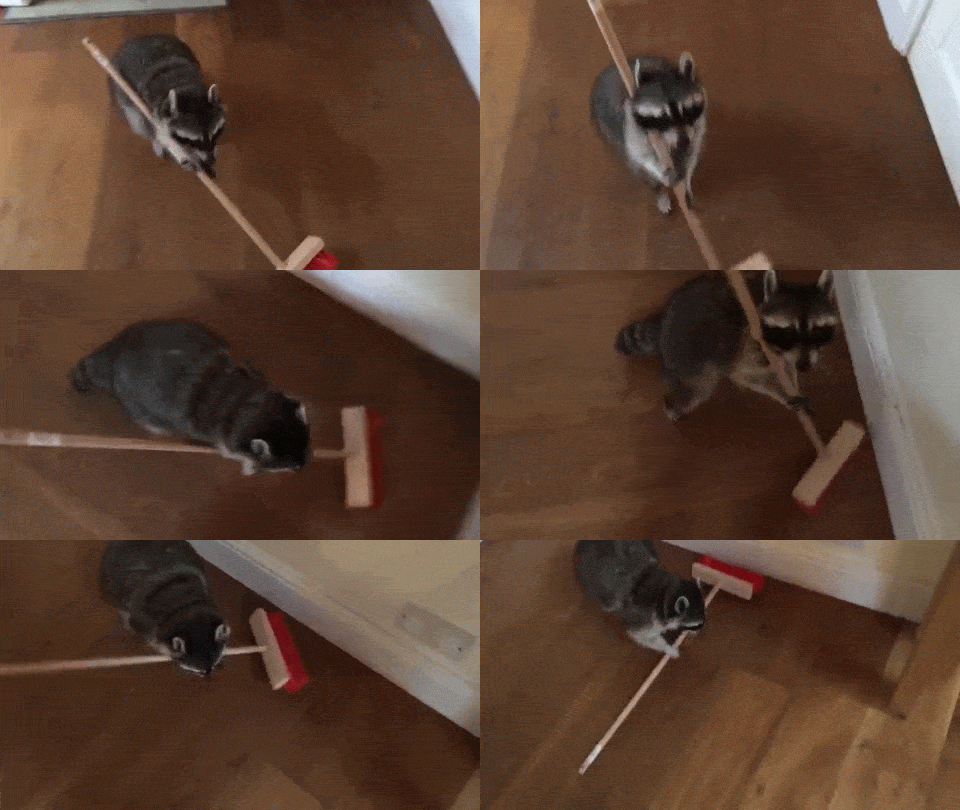
> A raccoon broke into a closed liquor store in Ashland, Virginia, drank scotch and whiskey from the bottom shelf, and was later found passed out on the bathroom floor after smashing multiple bottles. Relatable.
> After more than 3,600 entries by professional and amateur photographers around the world, the winners of the 12th International Landscape Photographer of the Year have been announced. See the photos here.
> Google says Gemini, its own AI chatbot, was the most-searched trending term across the world in 2025. Just like how your parents say you’re the favorite kid.
> A 14-year-old student from New York won a $25,000 prize after designing an origami-inspired structure that supported over 10,000 times its own weight.
> A French snail-farm supplying high-end restaurants says thieves stole roughly €90,000 (around $104,000) worth of snails, its entire fresh and frozen stock, just before the holiday season.


